Quick answer
A booth that works in Japan tells visitors in Japanese, in a few seconds, what you sell. Keep the front open, give buyers a seated meeting space, let them touch the product and offer printed materials to take away. Design within Japanese venue rules: walls usually 2.7 m, height limits from 3.6 m, no ceilings and fire-resistant materials only.
Key takeaways
- Put a short Japanese headline that says what you sell at the top of your back wall. RX Japan recommends a Japanese slogan with a number that proves your strength.
- Japanese business talks happen seated. Some shows, such as CONTENT TOKYO, require at least one table and chairs in every booth.
- Booth sizes vary. One koma is often 3 m × 3 m, but some shows use 2.7 m × 3 m or smaller.
- Ceilings are not allowed in principle, and all decoration must be fire-resistant with a label.
- Japanese venues use 100 V. Tokyo and Chiba run at 50 Hz; Osaka and Nagoya at 60 Hz.
On this page
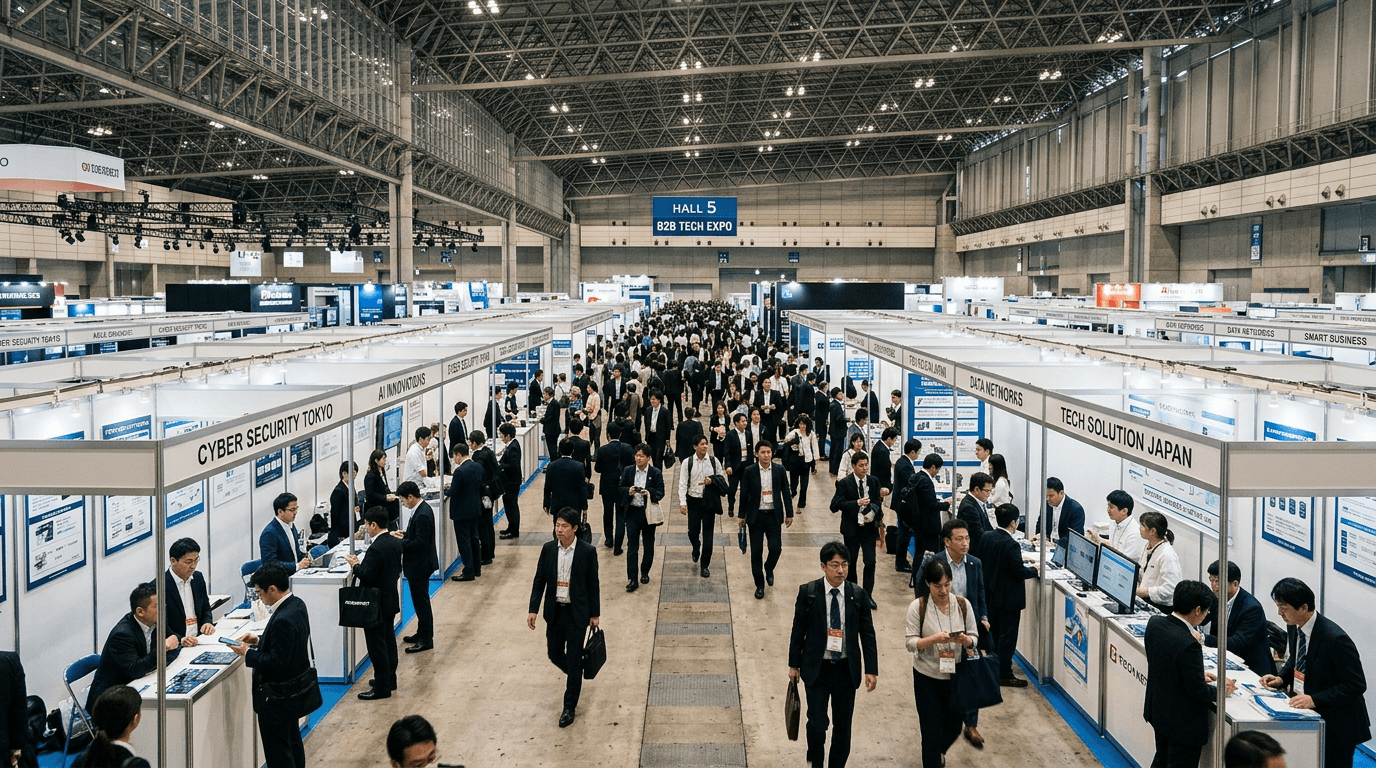
A booth that works in Las Vegas or Frankfurt does not always work in Tokyo. Japanese visitors often walk the aisles slowly, look carefully and decide later with their team. Many will not stop unless they understand in a few seconds what you sell. And Japanese venues have their own rules on wall height, ceilings and fire safety.
These 15 booth design ideas come from organizer advice for overseas exhibitors and from the exhibitor manuals of major Japanese shows. They work for a single 3 m × 3 m booth as well as a large island stand.
Start with the rules that shape your design
Before you sketch anything, read your show's exhibitor manual (出展者マニュアル, shuttensha manyuaru). Every show is different, but the rules below appear in most Japanese manuals. They decide what your design can and cannot do.
| Rule | What is typical | Example from a real exhibitor manual |
|---|---|---|
| Booth unit (koma) | Often 3 m × 3 m, but sizes vary | Tokyo International Gift Show: 3 m × 3 m. Health & Wellness Japan 2025: 2.7 m deep × 3 m wide |
| Wall height | Shell walls about 2.7 m | CONTENT TOKYO: back and side walls 2.7–3.6 m high |
| Height limit | Often 3.6 m; higher for large booths with a setback | Inter BEE: 3.6 m for 1–10 units and 4.5 m for 12–18 units (1 m setback); 6 m for 20+ units |
| Ceilings | Not allowed in principle | CEATEC: whole or partial ceilings prohibited without fire department permission |
| Materials | Fire-resistant, with a visible label | RX shows at Tokyo Big Sight: label each fireproof material in a visible place |
| Open flames | Usually prohibited | Sound Messe in Osaka: no open flames, including candles and incense |
| Shell walls | No nails, drills or staples | Health & Wellness Japan: use brackets, Velcro or double-sided tape |
| Meeting space | Some shows require it | CONTENT TOKYO: at least one table and chairs in every booth |
| Power | 100 V; 50 Hz in Tokyo and Chiba, 60 Hz in Osaka and Nagoya | Electrical work through the official contractor |
Our guide to booth rules at Japanese venues explains each rule in detail. The rest of this article is about what to do inside those limits.
15 booth design ideas for trade shows in Japan
1. Say what you sell in Japanese, in one line
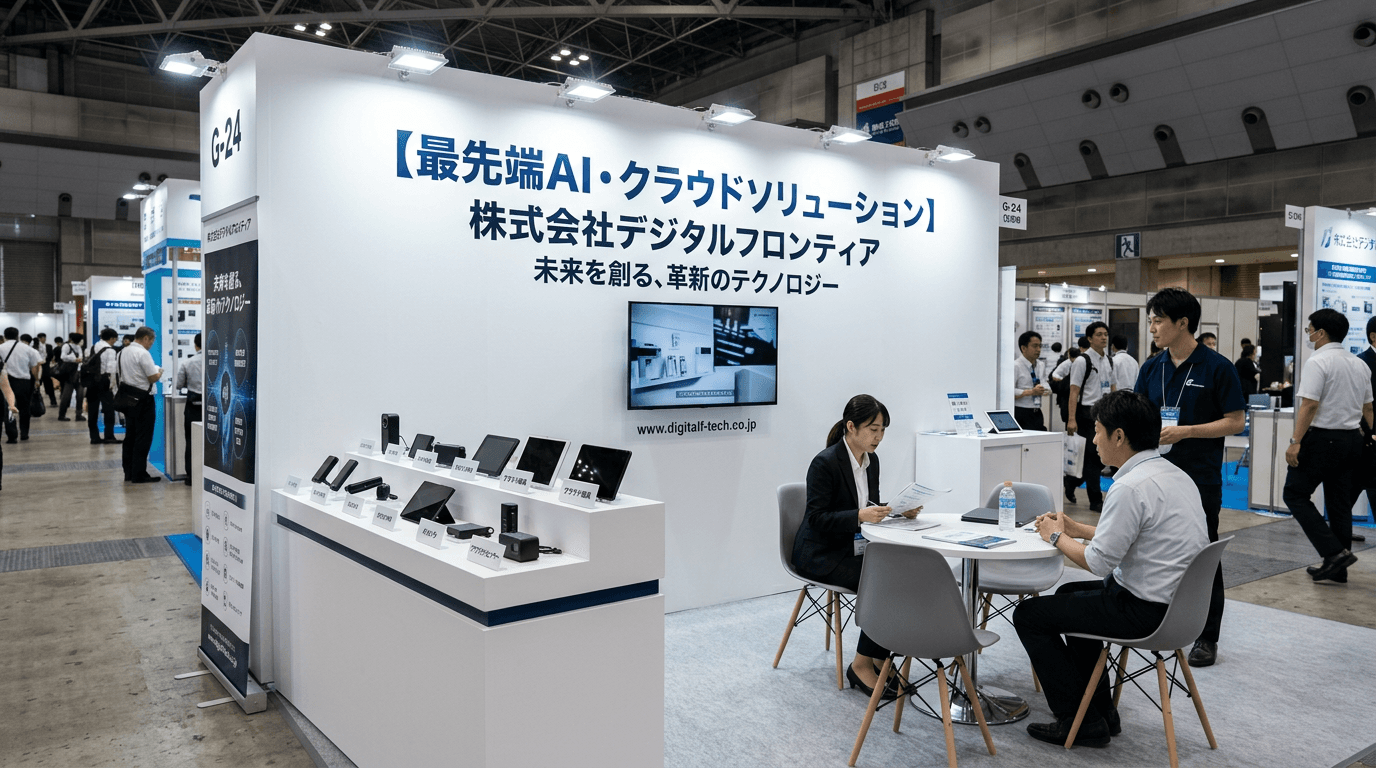
RX Japan, the country's largest trade show organizer, tells overseas exhibitors that a Japanese slogan is essential. The slogan should say what your product is, because many Japanese visitors are not confident in English. A clever brand line in English will not stop them. A plain Japanese description will.
Write one short headline, for example 「ドイツ製の業務用コーヒーマシン」 ("German-made commercial coffee machines"). Put your English line underneath in smaller type. Ask a native Japanese writer to create it. Do not use machine translation for your main headline.
2. Add a number that proves your strength
The same RX advice recommends a number in the slogan to show your strength. Japanese buyers trust concrete facts more than adjectives. Use years in business, installations, countries, certifications or a measured result, for example 「導入実績 40か国・1,200社」 ("Used by 1,200 companies in 40 countries").
Only use claims you can prove. Japan has strict rules against misleading advertising claims (the 景品表示法, Keihin Hyōji Hō), and buyers will ask for evidence.
3. Put the key message above head height
In a busy hall, people standing in the aisle hide the lower half of your booth. Place your company name and Japanese headline at the top of the back wall, above about 2 m, so people can read it from a distance. Keep product details and smaller text at eye level, where visitors read them once they have stopped.
Most shows also require a company name board. On shell scheme booths, the organizer often supplies the fascia. Check the spelling, and ask if a Japanese (katakana) name can be added.
4. Show clearly where you are from
For many Japanese buyers, overseas origin is a reason to stop. Importers walk the halls looking for products they cannot get in Japan yet. Show your country clearly, with a flag or a line such as "From Belgium" next to your Japanese headline. If you exhibit in a national pavilion, use the pavilion's shared look. Visitors who come to a pavilion are already looking for imports.
5. Keep the front of the booth open
Many Japanese visitors hesitate to step into a booth that feels closed or crowded with staff. Do not put a counter or table across the front. Place your product or demo at the aisle edge so people can look without committing. Put the meeting table further back. Staff should stand to one side, not in the entrance.
6. Build in a seated meeting space
Business talks (商談, shōdan) in Japan usually happen seated. Some organizers make this a rule. CONTENT TOKYO requires at least one set of table and chairs in every booth, because visitors asked for a place to negotiate while seated. RX Japan's general tips also call tables and chairs essential for business talks.
In a single koma, a small high table with two stools may be enough. In two or more koma, use a low table with three or four chairs, away from the aisle.
7. Let visitors touch and try
Japanese buyers expect to see the real product, not only a screen. The organizer of a Japanese seafood expo gave exhibitors simple advice: a booth does not need to be fancy, and products should be easy to see and touch. Bring working samples, cut-away models or a live demo. If you plan food tasting, check your show's sampling and hygiene rules first.
8. Show the product in a Japanese setting
Help buyers imagine your product in their business. The same seafood expo advised exhibitors to show how items can be used, for example arranging gift products in a box. Use photos of your product in a Japanese kitchen, office or factory. Show Japanese package sizes and a sample Japanese label. This tells buyers you have already thought about their market.
9. Make one small booth work hard
Most first-time exhibitors take one koma. A small booth works when it has one clear focus.
- One hero product at eye level, near the aisle
- One large back-wall graphic with the Japanese headline
- One roll-up banner at the open corner
- A catalog stand within reach of the aisle
- Two stools and a small table at the back
Use the full allowed height for graphics, not for clutter. Showing 20 products in 9 m² usually means visitors remember none of them.
10. Use a clear hierarchy: Japanese first, English second
On every panel, decide which language leads. For the headline and key benefits, lead with Japanese. Technical details can be bilingual or in Japanese with English below.
Use a Japanese typeface such as Noto Sans JP or Hiragino. Fonts made for Chinese use different shapes for some characters, which looks wrong to Japanese readers. Our guide to translating booth graphics into Japanese explains how to brief a translator and check the final artwork.
11. Plan printed materials as part of the design
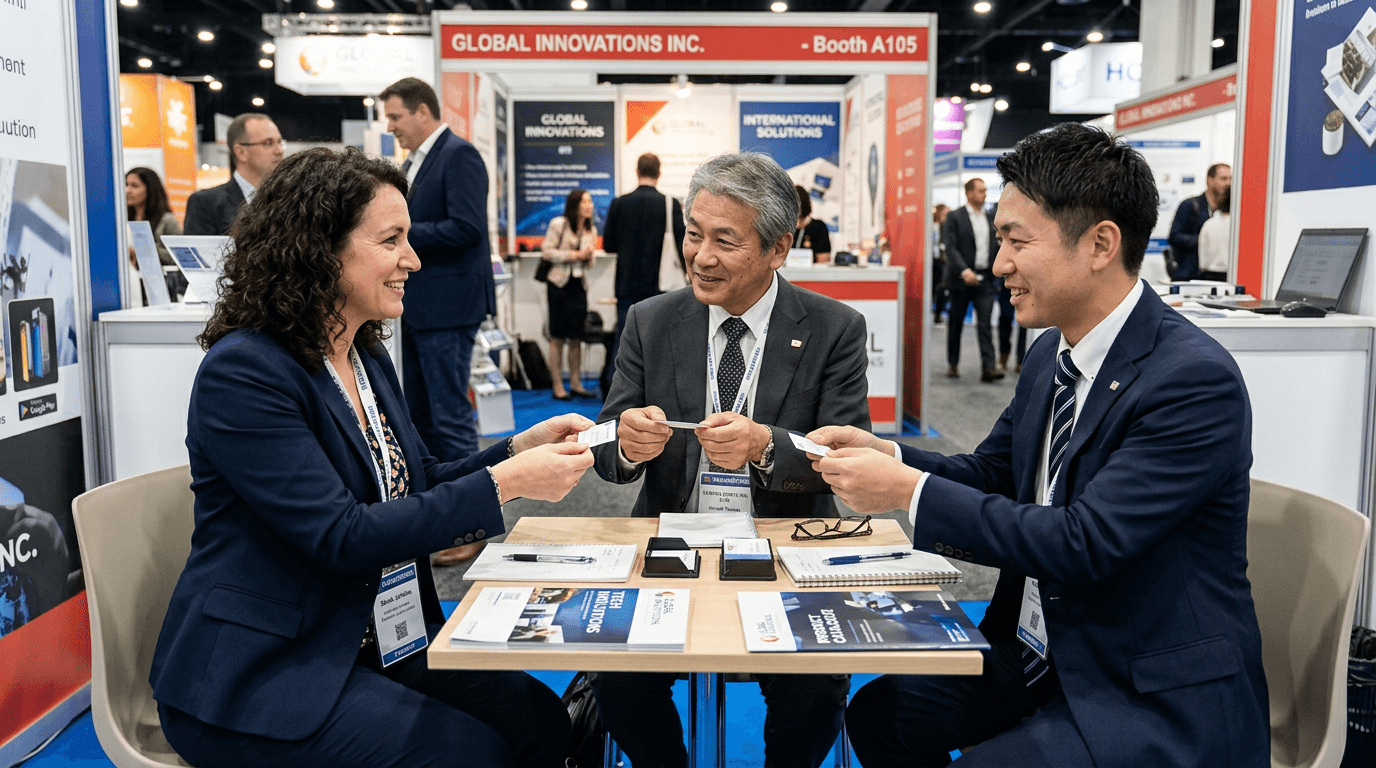
Japanese buying decisions are usually made by a team, not by the person at your booth. Visitors often collect catalogs to share with colleagues back at the office. Build a catalog rack into the design. Prepare a Japanese catalog or at least a one-page Japanese summary, and bring bilingual business cards (名刺, meishi).
You do not have to ship these from overseas. You can order roll-up banners in Japan (opens in a new tab) and bilingual business cards in Japan (opens in a new tab) and have them delivered to the venue or your hotel.
12. Light the booth properly
Exhibition halls are bright overall, but a booth without its own lighting can look flat. Use spotlights on your headline and your hero product. Before you bring equipment, check the power: Japan uses 100 V. Tokyo Big Sight and Makuhari Messe are in the 50 Hz area of eastern Japan, while INTEX Osaka and Port Messe Nagoya are in the 60 Hz area of western Japan. Order all electrical work through the official contractor named in your manual.
13. Keep it clean and calm
Simple booths with a clear focus usually do better in Japan than busy ones. Use plenty of empty space, two or three brand colors and large, readable type. Avoid walls of small text. If a panel needs more than 30 words, move the detail to a handout.
14. Add a QR code to a Japanese-language page
Many visitors will look you up after the show, often to share your details with a manager. Put a QR code on the back wall and on handouts. Link it to a Japanese-language landing page, not your English homepage. Include a short Japanese contact form so interested buyers can reach you without writing in English.
15. Design the staff space, not only the visitor space
RX Japan warns that Japanese visitors hesitate to approach a booth when staff are eating, sleeping or away from the booth. Plan a small closed storage area, behind the back wall or in a corner, for bags, drinks and stock. Then staff can take breaks out of sight.
Plan positions too: one person at the aisle to greet, one at the meeting table. Matching shirts and a name badge that shows languages, such as "English / 日本語", help visitors choose who to talk to.
Booth layouts by size
| Booth size | Typical area | What fits well |
|---|---|---|
| 1 koma | About 9 m² | One hero product, back-wall headline, one roll-up banner, catalog stand, two stools |
| 2 koma | About 18 m² | Demo area at the aisle, small meeting table with 3–4 chairs, storage behind a wall |
| 4 koma (corner or island) | About 36 m² | Two open sides, separate demo and meeting zones, closed storage room, higher graphics if the manual allows |
Shell scheme, package or custom booth?
| Booth type | What you get | Good for |
|---|---|---|
| Shell scheme / package booth | Walls, name board, carpet, lights and furniture from the organizer's contractor | First-time exhibitors, one or two koma, small budgets |
| Space only + custom build | Floor space only; you hire a booth builder | Larger booths and strong brand presence |
| Space only + modular system | Reusable frame system, often rented in Japan | Exhibitors who attend several shows a year |
Whatever you choose, give your booth builder the exhibitor manual on day one. Height limits, setbacks and fire rules affect the design from the start.
Booth design timeline for a Japanese show
| Time before the show | Task |
|---|---|
| 6 months | Choose booth type and contractor; get the exhibitor manual |
| 4 months | Agree the design concept; check it against height and setback rules |
| 3 months | Submit booth drawings by the manual's deadline |
| 6–8 weeks | Final Japanese copy, checked by a native speaker |
| 3–4 weeks | Order printing; confirm delivery to the venue during move-in (搬入, hannyū) |
| 1 week | Confirm staff roles, lighting, power and storage |
Print Japan's standard turnaround is 3–5 business days, and some products can be made in one day. Still, plan printing three to four weeks ahead so there is time to correct proofs.
Next steps
- Choose your show: The biggest trade shows in Japan
- Check the rules: Booth rules at Japanese venues
- Plan every deadline: Deadline Planner
- Need a booth builder or interpreter? Get help with your show
Frequently asked questions
What is a koma at a Japanese trade show?
A koma (小間) is the standard booth unit at Japanese trade shows. It is often 3 m × 3 m (9 m²), but sizes vary by show. One 2025 show used 2.7 m × 3 m, and some smaller shows use 2 m × 2 m. Some shows also offer half-koma spaces. Always check the size in your show's exhibitor manual before you design.
Do I need Japanese text on my booth?
Yes, if you want Japanese visitors to stop. RX Japan, the country's largest organizer, advises overseas exhibitors to display a Japanese slogan that says what the product is, because many visitors are not confident in English. Put one short Japanese headline at the top and keep English as the second language.
How tall can my booth be in Japan?
It depends on the show and booth size. Standard walls are usually 2.7 m. Many shows allow up to 3.6 m, often with a 1 m setback from the aisle. Large island booths may go higher: Inter BEE, for example, allows 6 m for 20 or more booth units. Your exhibitor manual gives the exact limits.
Can I have a ceiling or use candles in my booth?
Usually not. Japanese fire rules do not allow booth ceilings in principle; you need permission from the local fire station for any exception. Open flames, including candles and incense, are prohibited at many venues. All decoration materials must be fire-resistant and carry a fire-resistant label.
What voltage do Japanese exhibition venues use?
Japan uses 100 V. The frequency is 50 Hz in eastern Japan, including Tokyo Big Sight and Makuhari Messe, and 60 Hz in western Japan, including INTEX Osaka and Port Messe Nagoya. Check that your screens, motors and chargers support this. Electrical work in the booth must be ordered through the official contractor.
Should I print my booth graphics at home or in Japan?
Both work. Printing at home lets you check colors in person, but you must ship the graphics and they must meet Japanese fire rules. Printing in Japan avoids shipping and customs, and a local printer can deliver to the venue or your hotel. Either way, have a native speaker check all Japanese text first.
Sources
- RX Japan (Manufacturing World) — Exhibiting in Japan: guide for overseas exhibitors
- CONTENT TOKYO — Regulations for booth construction
- Inter BEE — Booth height limitations
- CEATEC — Exhibition manual: booth standards
- Health & Wellness Japan 2025 — Exhibitor manual (Informa Markets Japan)
- Kiryu City — booth specification at Tokyo International Gift Show Autumn 2026 (Japanese PDF)
- Japan International Seafood & Technology Expo — tips for exhibitors (via Fishnet)
- Exhibitor Online — Exhibiting in Tokyo: general facts and tips
- Sound Messe in Osaka — Exhibition decoration regulations
- RX Japan (Highly-functional Material Week) — Tips for exhibiting
Shows mentioned
- 9–12 March 2027Food & Beverage
FOODEX JAPAN 2027
Tokyo Big Sight, Tokyo
Exhibitors3,238Visitors73,842Overseas exh.2,126 - 17–19 February 2027Electronics & SemiconductorsManufacturing & Machinery
NEPCON JAPAN 2027
Tokyo Big Sight, Tokyo
ExhibitorsTBCVisitorsTBCOverseas exh.TBC - 17–19 February 2027Food & BeverageRetail & Store Design
SUPERMARKET TRADE SHOW 2027
スーパーマーケット・トレードショー
Makuhari Messe, Chiba
ExhibitorsTBCVisitors81,000Overseas exh.TBC